As a consequence of my recent article “INTELIGENCE + TECHNOLOGY IN THE MODERNIZATION AND AUTOMATION OF THE NEW AND EXISTING SHIPYARDS”, I have received a lot of responses and requests about MARTEC.
Many of them are
surprised at the fact that it does exist a Spanish Company with long
experience in automating Shipyards. For that reason, I have decided
to interview MARTEC in order to provide some clarification for
many Shipyard´s Directors and production Engineers, who still have
not planned to invest in improving production/productivity or do not
know exactly how to deal with, which nowadays is absolutely vital to
maintain any option of competitiveness.

Pedro Otazua Mr.
Galdos, when did you start with Shipyards Automation?
Miguel Galdos.- We have been in this
business since 1991, when we visited the Shipyard Astilleros
Españoles de Sestao (La Naval) (Bilbao-Spain) and they proposed us to
study a cutting and preparation line of profiles with the aim of
increasing their production capacity.
By that time, the
Shipyard La Naval had a robotized oxigas cutting line, which was the
first one in Spain. This operation was manually made in all
shipyards. I do remember it took us a long time to design a new
concept and to create a specific software, capable to monitor
automatic operating of the line. We achieved a spectacular result
since the production capacity of the old line was quadruplicated
P.O.- I suppose that the SY was
satisfied. After that, did they ask you for any other projects?
M.G.- Yes, indeed. Since then,
they took a great confidence in us and we were appointed to execute
the majority of their investments made up to the end of decade. We
developed many projects for different production lines that
afterwards were executed: equipment for mini-panels fabrication, flat
and curved sections with specific transport systems, and equipment
for pipe production workshop etc. etc
P.O.- Was that confidence the
only factor taken into account by the SY to place the different
orders? Because you didn’t have any previous experience with these
systems, did you?.
M.G.- I think we made a good impression because a robotized cutting line and the development of its correspondent software, was something as science fiction at that time in Spain. I suppose they thought that we would be able to get quite similar results in other fabrication processes. I also think they considered to be very positive the fact of proximity, providing a fast service.
M.G.- I think we made a good impression because a robotized cutting line and the development of its correspondent software, was something as science fiction at that time in Spain. I suppose they thought that we would be able to get quite similar results in other fabrication processes. I also think they considered to be very positive the fact of proximity, providing a fast service.
Vitoria is less than one
hour from the SY by road. On top of that, we speak the same language.
It should be beard in account that they were used to asking
quotations from America, Germany … This means that post sale
service gets always very problematic and expensive, unless you have a
good qualified own maintenance service. Honestly, I believe that we
were a discovery for them and, on the other hand, it was a good help
for us to enter into a new business opportunity. In case that our
equipment are installed out of Spain, we have already decided to set
up a post sale service there.
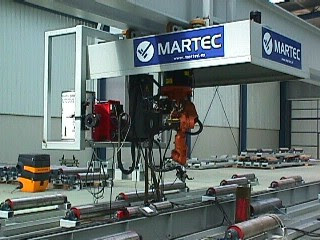 P.O. Before now, did you have
any experience in the field of automation?
M.G.- Yes, since 1972, my
whole professional life has been connected with automation. It is a
long history during which I have seen the advantages of production in
line, electronic development, the birth of the Numeric Control, the
Robotic implantation and technical computing. Always with the same
target: to improve productivity.
P.O.- Aren´t you surprised about the low rate of automation in our SYs ?
P.O.- Aren´t you surprised about the low rate of automation in our SYs ?
M.G.- Yes I am, and it is
surprising for someone who is so familiar with it, seeing throughout
all these years the rate of automation reached by other sectors like
automotion, electronic, electrodomestic and others. Certainly, they
are not comparable sectors as some of them are for massive production
of the same products and this doesn’t occur in the naval sector.
However, there are many things that can be done and haven’t been
done yet.
P.O. How do you think
shipyards should undertake the improvement of production?
M.G.- Assuming that the SY has
already come to the conclusion that this has to be done, the first
thing to do is to draw up a Director Plan which clearly defines the
objectives to be reached. This Director Plan might be done by the SY
or with assistance of some expert advisors.
P.O.- Can MARTEC assist SY in
elaborating such Director Plan?
M.G.- Yes, of course.
P.O.- To my understanding, the automation equipment is rather expensive. Is it possible to draw a plan in terms that require step by step investment?
P.O.- To my understanding, the automation equipment is rather expensive. Is it possible to draw a plan in terms that require step by step investment?
M.G.- Well, the equipment has a
high price because it is big and built in high tech technology in
many cases and, of course, the investment can be intelligently done
step by step, introducing at first place that equipment providing the
SY with higher profitability. It should be emphasized that during the
first phase with only ordering/arranging streams, storing, internal
mobilisations, huge results can be reached with relatively reduced
investments. Actually, at the end of the automation process is where
higher investments are required to obtain a longer-term return of
investment (ROI).
P.O.- Is the production
improvement the only reason for automating the SY?
M.G.- It is generally the first
reason but not the only one. In a SY, big and heavy loads are handled
and a lot of welding and cutting work is carried out. To handle big
and heavy loads represents risk and slow work if you can’t make use
of proper systems for transporting and mobilisation. With regards to
the welding job, when executed manually, this is a very hard job,
submitted to breathing dangerous gases, to the action of ultra violet
rays, heat and to non-recommendable positions of the welder. The
welder needs more rest times during the job and his efficiency will
be very low in comparison with a machine. This kind of job, because
of its danger, is one of the most demanding in automation as in
other industrial sectors.
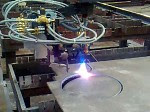
P.O.- And, what can you tell me
about quality?
M.G.- Effectively, quality is enormously improved. The assembly work made in the slip way is very unpleasant and normally unpredictable. For that reason, we will try to minimize those problems reducing the job in the workshop but with the maximum possible precision. The suitable dimensional accuracy can only be achieved by using modern machines capable to obtain it. I would also like to emphazise that automatized welding is much more reliable than when manually executed. Although we have qualified and homologated welders, we should be conscious that welding represents an unpleasant job and the adverse emotions are also a handicap for a worker, all which affects to the state of his mind, making this job much more irregular than a well programed and optimized machine.
M.G.- Effectively, quality is enormously improved. The assembly work made in the slip way is very unpleasant and normally unpredictable. For that reason, we will try to minimize those problems reducing the job in the workshop but with the maximum possible precision. The suitable dimensional accuracy can only be achieved by using modern machines capable to obtain it. I would also like to emphazise that automatized welding is much more reliable than when manually executed. Although we have qualified and homologated welders, we should be conscious that welding represents an unpleasant job and the adverse emotions are also a handicap for a worker, all which affects to the state of his mind, making this job much more irregular than a well programed and optimized machine.
M.G.- The production in line
means the change from the artisanal production to industrialized
production and it came from the hand of automotive industry. Who
doesn’t know or has never seen any visual reports of the current
automotive production line?. Actually the question is to trace the
target of how many units of production should be constructed per unit
of time: hour, day, week etc. Starting with this data, the working
construction of the production unit (car, naval section) should be
divided into parts of whose time of execution (cycle time) should be
equivalent and coincident with the target. For example, if we want to
produce one section per day, it is necessary to divide the
construction of the section in phases whose construction or
fabrication can be executed in one day. Then the system is like a
chain in cyclical motion, where the phases are produced
simultaneously and when the cycle or phase time comes to an end, all
the operations will be completed. That means that in each cycle, the
section comes out from the last phase, ready to be sent to the
slipway for assembly, every day in this case.
P.O.- Yes, this can be done by
building the section over fix places and multiplying the number of
them as currently or usually is done, isn´t it?
M.G.- Yes, sure, but this is
the good question. When producing in artisanal way, by means of
multiple fix places, every thing is mixed up: different materials are
over in the air moved by different cranes from one place to another.
Cranes are slow, they require a qualified crane operator and they can
make only one delivery to each place at the same time, and as a
consequence, other places have to wait in many cases. It happens the
same with other resources. Each section, during construction, should
have all human and material resources at its disposal. The manual
welding, cutting, handling, are all mixed up, losing a great deal of
effectiveness. The worst thing is that this kind of construction
can’t be automatized and practically doesn’t admit any
improvement. On the contrary, the “production in line” makes use
of not only highly qualified workers, but also machines adapted for
each phase and susceptible of continuous improvement, by means of a
constant finding of the “bottle neck” to eliminate it in many
cases through a partial or a total automation. The higher
specialization of the operation together with its partial or total
automation, contributes to a greatly improved productivity and
quality. We are not talking about improving a 15 or 20%. We are
talking about multiplying by 2 or 3.
P.O.- You have indirectly
referred to the safety. Can you explain more clearly how can safety
be improved by the automation?
M.G.- As I said before, handling heavy and big loads by cranes implies important risks. Clear and strict standards and protocols regulate the handling of cranes and even though, it is not always possible to avoid incidents or casualties which in most cases are fatal accidents. The main rule, whenever possible, is that all loads should be moved at floor level by means of specialized equipment as the hydraulic carriages that we use to transport the sections from one phase to another in the in-line production. The order which resuls from the in-line production, together with an in-put out-put of materials safe and well defined, -without crossing and mantaining the alleyways free of materials- are essential. The replacement of welders by automatic machines will prevent them from eyes and joint injures. The better grade of skills and knowledge of the qualified staff in their specialized working field, the safer will get their environment.
M.G.- As I said before, handling heavy and big loads by cranes implies important risks. Clear and strict standards and protocols regulate the handling of cranes and even though, it is not always possible to avoid incidents or casualties which in most cases are fatal accidents. The main rule, whenever possible, is that all loads should be moved at floor level by means of specialized equipment as the hydraulic carriages that we use to transport the sections from one phase to another in the in-line production. The order which resuls from the in-line production, together with an in-put out-put of materials safe and well defined, -without crossing and mantaining the alleyways free of materials- are essential. The replacement of welders by automatic machines will prevent them from eyes and joint injures. The better grade of skills and knowledge of the qualified staff in their specialized working field, the safer will get their environment.
P.O.- Mr Galdos, would you like
to add anything else?
M.G.- Yes, I would like to set clearly, that the human being is intelligent and capable when using his brain, but physically we are very fragile. Let us make use of our intelligence and let us use machines to execute heavy, monotone and/or dangerous works as long as the state of the art allows it. There shouldn’t be used persons to execute jobs that can be done by machines. Humans can’t compete with them, but their intelligence is greater, and by using this intellingence is how the human being has highly developed and progressed.
M.G.- Yes, I would like to set clearly, that the human being is intelligent and capable when using his brain, but physically we are very fragile. Let us make use of our intelligence and let us use machines to execute heavy, monotone and/or dangerous works as long as the state of the art allows it. There shouldn’t be used persons to execute jobs that can be done by machines. Humans can’t compete with them, but their intelligence is greater, and by using this intellingence is how the human being has highly developed and progressed.
P.O.- I am aware that many
aspects about this issue have been left behind. May I contact you for
any further interviews?
M.G.- Yes definitely. I would
be very happy.
Finally, I want to thank
you for the interview and allow me to facilitate your e-mail
(m.galdos@martec.es),
in case anyone were interested in contacting directly with you.
Note: For the management of projects in other countries (anywhere in the world) we are promoting a network of after sales next to the facility.


